


MILES KINGTON INTERVIEWS
Sir Arthur Conan Doyle
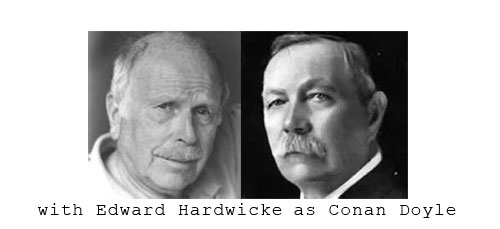
broadcast on Radio 4 26th Jan 1993
KINGTON Sir Arthur Conan Doyle, it's a great pleasure for me to…
DOYLE Well, I am sure it's a great pleasure for me, too, but may I ask one question before we begin?
KINGTON Of course.
DOYLE Are you going to ask me any questions about Sherlock Holmes?
KINGTON I thought the subject might possibly crop up somewhere before the end of the interview…
DOYLE A pity.
KINGTON Well, I know about your famous distaste for the great detective, and your efforts to get rid of him, but I thought at the very least I might ask you about that distaste…
DOYLE Hmmmm!
KINGTON And the fact is that without Sherlock Holmes, it might not be thought worth interviewing you at all.
DOYLE That's a little cruel! True, though. How many artists there are who are famous for the one thing they want to be forgotten. I remember Oscar Wilde saying to me…
KINGTON You knew him?
DOYLE Oh yes. Does that surprise you?
KINGTON It does, slightly. You don't seem at all the same kind of…
DOYLE The effete Irish playwright and the bluff man of action, eh? Posing Oscar and red-blooded Sir Arthur? But beyond those clichés we had plenty in common. We were both writers. We were both Irishmen, by origin. In fact, if you look through our works you will find traces of rather treasonable Irish patriotism. I have a short story about an English regiment fighting in Africa, in which the Irish soldiers rally round the Irish national flag rather than the Union Jack. And Oscar was once asked if he would walk out of a concert at which someone sang a song with full-blooded Irish republican sympathies. And do you know what he said?
KINGTON No…
DOYLE He said: That depends entirely on how well it was written and sung.
KINGTON How did you meet Oscar Wilde?
DOYLE At a dinner arranged by an American publisher, called… what was his name? Lippincott. He was visiting this country and wanted to meet some promising young writers. Three of us were gathered, including me and Wilde. As a result of that dinner, I was commissioned to write The Sign of Four, and he was commissioned to write The Picture of Dorian Gray. Couldn't be two more different books!
KINGTON What did you make of Wilde?
DOYLE A tremendous talker. A wonderful man. He towered above us all. Also…
KINGTON Yes?
DOYLE This may sound a bit childish, but he had read and enjoyed a book of mine. That does make a difference.
KINGTON Which book?
DOYLE I don't suppose you have ever heard of it, but it was called "Micah Clarke".
KINGTON A historical novel, set in the time of the Mayflower?
DOYLE Good Lord, you have actually read it!
KINGTON Well, after falling in love with Sherlock Holmes, I naturally went on to your other works. Many people must have done this.
DOYLE Sherlock Holmes… yes…
KINGTON The man you tried to kill…
DOYLE And that everyone has tried to bring back to life. Do you know, they are still writing new adventures for the man? Unbelievable. And they are still trying to find real-life models for him! This professor, that doctor.. all so childish.
KINGTON It seems to me that your distaste for Holmes is not actually distaste for the great man at all - it is a transferred affection for your other children. You resent Holmes because he detracts from the praise you wanted showered on your other books.
DOYLE Well, I think two things need to be said there. One is that you are absolutely right, but that I never sought to hide it - a child of ten could have seen it. The other is that I didn't want praise showered on my other books - just judiciously rationed out. I think Holmes is over-praised. I think the others are under-praised. That is all.
KINGTON Which of your other books do you think most deserve praise?
DOYLE The British have always had an ambivalent attitude to literature. There are the writers they know they should enjoy, and the writers they really do enjoy. The writers who are taught, and the writers who are read.
KINGTON The ones who win prizes, and the ones who win fortunes.
DOYLE Perhaps. Someone like Daphne Du Maurier is a deep favourite with the British public, but I do not think she ever won an award, or was taught at University. She told a story too well.
KINGTON Do I detect an unfulfilled ambition here? Do you feel you were read too widely, and not deeply enough?
DOYLE There may have been a time when I felt that, especially when the public clamoured for another Holmes story, and I really wanted them to clamour for another vast historical novel, but my feet were always firmly on the ground, really, thanks to my early experience as a writer. I mean, I used writing very deliberately as a job, as a way of getting out of medicine. If I had stuck to medicine, I would have gone bankrupt. I found out in time, that I had a knack for story-telling, and I used that to start a new career. Now, when you have used writing as a ladder out of poverty, you find it very difficult to see yourself as an artist on a pedestal. So, no, I don't really regret not having been considered for the Nobel prize. I was always polite enough not to make fun of the Holmes worshippers directly. I was usually too busy getting on with another book, or creating another character, like Brigadier Gerard, or Professor Challenger…
KINGTON The man who found the Lost World, where dinosaurs roamed and pterodactyl flew…
DOYLE Yes, I was one of the first on the dinosaur scene. I always rather like old Professor Challenger and his stories, but they never quite became best-sellers.
KINGTON If they had, would you have still liked him?
DOYLE You mean, Sherlock Holmes became tiresome because he was so popular, and the others would equally have become tiresome if the public had taken them to their heart?
KINGTON Yes.
DOYLE And I would have had to send Brigadier Gerard to his death over the Reichenbach Falls?
KINGTON Yes.
DOYLE It's an idea… Mark you, I did go to the Reichenbach Falls myself. . .
KINGTON What, to research the fight between Moriarty and Holmes?
DOYLE No, no, no, that's not the way it works. I went there with my wife, for an Alpine walking holiday, and while there conceived vaguely the idea of this tussle beside the chasm. You have the experience, and then later you see how you can use it. That's how writing works. Let me give you another example. On the same holiday I saw a small hotel, inn, perhaps, perched in such an inaccessible place, on a hostile crag, which was often snow-bound, that I was told it was sometimes cut off from civilisation. I conceived the idea at the time of a story which would take place inside the hotel, when four or five guests were isolated there, unable to leave, and unable to bear each other's company. Where would it lead? - Tragedy? Comedy? Melodrama? I could never quite decide. Years later, I found Maupassant had written that short story already, set in a hotel, with the same sort of company of incompatible fellow guests. And the extraordinary thing was that he had set the story in the very same hotel on the same Alpine outcrop, having had the same idea as me on a similar trip to Switzerland. That's how writers work, I think.
KINGTON You helped introduce skiing to Switzerland, I think.
DOYLE Yes, I did, but I don't see…
KINGTON It just occurred to me that it's hard to think of Maupassant introducing a sport anywhere. Even into his short stories. But you were a great sportsman…
DOYLE Was I? Well, I certainly boxed… and I played cricket… I played against W G Grace once, you know…
KINGTON How did you get on?
DOYLE He got me out. On the other hand, I got him out!
KINGTON I think it's true that when you went on a lecture tour of America, you took your golf clubs with you…
DOYLE That's right - I did! I remember, I went to visit Rudyard Kipling who was living over there at the time, and took my clubs on the visit, and we played around his grounds. Much to the consternation of the Americans who, if I remember rightly, had not yet taken up golf and didn't know what we were doing. It's hard to imagine America without golf now…
KINGTON I get the impression that you didn't always like the Americans.
DOYLE Well, they are a curious lot. What made you say that?
KINGTON There is an American woman at the beginning of "Tragedy of the Korosko", who has come to Egypt almost with the sole intention of airing the country's social ills, in which aim she is clearly doomed to failure…
DOYLE Oh, yes, the original do-gooder. I think I was a little cruel in her depiction.
KINGTON It's very funny.
DOYLE Hmmm… Now, it's interesting that you should mention "Tragedy of the Korosko", because that book came about in exactly the same way as the Maupassant story. I was on holiday in Egypt, with my wife again as it happens - in those days, we used to winter in warm countries to get away from the English snows and frosts, but nowadays you go to warm countries when it is warmest in Britain, and at Christmas time you go skiing in the coldest countries you can find, which has always struck me as willful behaviour - anyway, we were on a boat going up the Nile to Aswan, and it was a perfectly uneventful trip, but there were raids by the desert dwellers from time to time, on civilised settlements by the Nile, or some flaring up again of the Muslim-inspired rebellion which led to the death of Gordon, the relief of Khartoum and all that… and it occurred to me to wonder what would happen if a boat, just like ours, fell into the hands of Islamic insurgents. We might all be slaughtered, of course, which wouldn't make much of a book, but we might all be kidnapped and taken to captivity. In which case it would be amusing and instructive to study the reactions of a bunch of mixed Europeans, wrenched out of their normal comfortable life into a world of tents and primitive food, and forced to come to terms with a) each other, b) a religion and a cause of which they knew nothing. We all have idle day-dreams like that. What makes the writer different is that it itches until he has to write it down and find out what happened, or how it works out. I did that, and wrote the "Tragedy of the Korosko". Two things strike me about the book. One is that it is never mentioned today, as if it were totally outmoded and hopelessly outdated. The other is that all reports coming from Egypt today are of Muslim fundamentalist attacks on European travellers, the very thing I was talking about a hundred years ago.
Well, I don't say that a book written a century ago in the same subject will be very relevant today. But I do say that I fail to notice any modern living writer at work on the subject of violent clashes between old beliefs and new.
KINGTON I must say, I have noticed over the years that you seem drawn to violence.
DOYLE In what way?
KINGTON Many of your stories contain quite gruesome episodes, sometimes of battle injuries, sometimes of torture. Engineer's thumb being severed, people being squashed to death…
DOYLE When you've been a doctor, things like that are fairly commonplace.
KINGTON True, but there were many doctors who turned to writing, such as Somerset Maugham, who never caused offence to the squeamish. It has been suggested that there was a side of you which was rather fascinated by cruelty…
DOYLE Oh? By whom?
KINGTON By people who knew you. And I came across curious evidence of this not so long ago. We have a body in this country now called the Broadcasting Standards Authority, which was headed by a man called Lord Rees-Mogg.
DOYLE Curious name.
KINGTON Curious man. And when he was first appointed head, he was asked to name examples of things on television which he found distasteful. And he gave as examples gory happenings in a televised Sherlock Holmes series, things which he said were far too bloodthirsty and not in the proper Holmes spirit. I looked up all the things he instanced, and without exception they were as written by you, not as invented by the TV company.
DOYLE I wouldn't pay too much attention to these heads of tribunals and commissions, if I were you. In my day it was just the same. I never quite realised it until I got involved in a couple of real life detection cases…
KINGTON What, the Oscar Slater one? And the one with the man whose name I can never remember?
DOYLE Yes, I can't remember it either - anyway, people kept writing to me to ask for help with miscarriages of justice, as if they couldn't tell the difference between Conan Doyle and Holmes, and a couple of times I was prevailed upon to do a bit of amateur detection, and the police bungling was so obvious that on both occasions I was able to prove, or at least suggest very strongly, the suspect's innocence. In both cases, as I remember, the accused was released, but not granted a pardon. I pressed for a pardon, and it was then that I came up against the wall of silence, the unspeaking inertia, which the ruling classes in this country are able to exert. The very idea of admitting openly that justice could miscarry, that the law could be an ass, that they presided over a faulty system, was more than they could bear. I encountered the same official stone-walling when I was writing my history of the Great War. The obstruction - the censorship - the sheer bloody-mindedness! If I ever felt part of the establishment, I realised then that I was still an outsider. Which is where a writer must be, of course. On the outside.
KINGTON There is one part of your life we have not touched on at all, and that is the increasing interest in your lifetime in spiritual, or rather, spiritualist matters. Which rather came to obsess you.
DOYLE Yes, it did.
KINGTON And now you are in a position to say whether all the things you believe about the after-life are true?
DOYLE Yes, I am.
KINGTON And…?
DOYLE And I am sure you will understand if I tell you that I couldn't possibly tell you.
KINGTON I see. Well, perhaps you could tell me just one thing. Years ago I used to live in London near a spiritualist centre, and I went there once on an Open Day. Well, the first thing that caught my eye was a book by you, which I had never heard of. It was claimed to be the first book written by you since your death. Transmitted, presumably, via a medium. What I want to know is, was it really by you?
DOYLE Did you look at the book?
KINGTON Yes.
DOYLE What did you think of it?
KINGTON Badly written.
DOYLE I hope that answers your question.
KINGTON Yes. I can see that even after you have become a spirit, you still stay a writer.
DOYLE Well, it's not quite as simple as that… But you'll find out one day.
KINGTON But there is life after death?
DOYLE The question is actually meaningless. There is no such thing as death, as you visualise it. Do you believe in immortality?
KINGTON I tend to believe that… Sherlock Holmes may be immortal.
DOYLE So we come back to him at the end, do we? Well, yes, never having lived I suppose there is no reason why Holmes should ever die.
KINGTON And you don't resent that?
DOYLE No. I have learnt to..... I was going to say, I have learnt to live with it. That's not really the right expression.
KINGTON Does it worry you that Sherlock Holmes is more famous than you are?
DOYLE Not in the least. I have come to see it as the compliment it really is. And in any case, we don't do a lot of worrying here.
KINGTON Sir Arthur Conan Doyle, thank you very much.
DOYLE Not at all. And next time, perhaps you would ask me more about Dr Watson.
KINGTON I will, I will.
The Miles Kington Interview with Sir Arthur Conan Doyle was broadcast on Radio 4 26th Jan 1993
Edward Hardwicke played Conan Doyle
Miles Kington played himself