


MILES KINGTON INTERVIEWS
5.Nostradamus
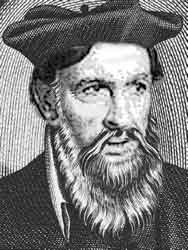
Nostradamus performed by Robert Stephens
Miles Kington played himself
KINGTON Monsieur Nostradamus - if that indeed is the right way to address you . . .
NOS Well, neither name is strictly accurate. After all, my family name was Nostradame, and I was christened Michel de Nostradame. I only changed it to Nostradamus later.
KINGTON It wasn't a very big change. Just the last letter. If you are going to change your name, wouldn't it be worth changing it a bit more drastically?
NOS Well, I wasn't really changing my name - I was making it a bit more what you would nowadays call up-market. It was quite the fashion in those days for people who aimed at being talked about to make their names sound a bit grand, a bit Latin. And of course it has always been grand to have just one name. So I was following people like Erasmus and Paracelus. . .
KINGTON So it was a deliberate attempt to become famous?
NOS Oh, no. It was a way of finding a name which could become famous. And I never liked being called Michel Our Lady, which of course is what Nostredame meant.
KINGTON So I should call you just Nostradamus, not Monsieur Nostradamus. . .
NOS Certainly not em>monsieur! Doctor if you like. Professor if you like. But monsieur. . .that sounds a little unqualified. . .
KINGTON You did qualify as a doctor, did you not?
NOS Oh, yes. For what it's worth. To become a doctor in my day you didn't have to know much about curing people, but you did have to parade your ignorance fluently in three different languages. . .
KINGTON What was the state of medicine like in the sixteenth century?
NOS Lamentable. Superstition, mumbo-jumbo and guesswork. What was so extraordinary was that there was never any feeling of experimenting. You simply did what your forefathers had done and hoped for the best. People had always bled patients, for instance, so they went on bleeding them. The fact that it did them no good and often killed them seemed to have no effect on the doctors at all.
KINGTON But you became known as an effective doctor, did you not?
NOS Yes, I did.
KINGTON In the plague years in France?
NOS Well, the plague was never very far away in the south of France. You only needed a bad flood or something like that - and there is nothing like a flood for spreading a disease efficiently - and the plague would sweep across the country. I have seen whole cities deserted, with the live habitants fled and the dead ones lying unburied. The plagues of the Old Testament never seemed very far away in those days.
KINGTON And how did you as a doctor tackle things like the plague?
NOS Oh, I tried two very revolutionary things. One was not to bleed anyone. The other was to give them fresh air, and fresh water, and exercise.
KINGTON Was that revolutionary?
NOS Revolutionary? It was almost regarded as witchcraft! I used my common sense, you see, and I realised that infection was borne on unsafe drinking water, most of it from wells. So I told my patients: No more well water! Only running water! And of course it worked. It was bleeding people that was the real witchcraft.
KINGTON Of course, it depends how you define witchcraft. If you mean claptrap. . .
NOS Yes, well nowadays it's quite fashionable to look beyond orthodox religion and express belief in the occult, but in my day it was courting disaster to sound as if you believed in bizarre beliefs. That is why I wrote all my predictions in a kind of shorthand, full of anagrams and back to front words. . .
KINGTON To avoid accusations of witchcraft?
NOS Of course.
KINGTON But surely to put out predictions in strange-sounding language also sounds a bit like witchcraft?
NOS Well, you could say that the Church was guilty of the same thing. There was the Bible, the good book, the holy book, the fount of all knowledge, and it was written in a language that nobody in the street could understand. It was against the law to print the Bible in a spoken language. Did that make the Pope a witch? Putting out God in a strange-sounding language?
KINGTON Well. . .
NOS I think not.
KINGTON You were a Christian, were you not?
NOS Of course.
KINGTON Although I think your family was Jewish in origin?
NOS That was the rumour.
KINGTON And the family turned Catholic in order to avoid persecution?
NOS So I have heard.
KINGTON Is this in fact true?
NOS Look, you didn't need to be Jewish in order to be persecuted in those days. Being Protestant was bad enough. You know that a few years after I died King Charles ordered all the Protestants in Paris to be killed?
KINGTON St Bartholomew's Night. . .
NOS Massacre - correct. Just over 400 years ago - in the capital of France - massacring people for being in the wrong department of Christianity! Well, you can imagine that I had to be very careful in anything I did, to make sure it did not seem un-Catholic. I did not want to be taken away by the Inquisition for my medicine, or my predictions . . .
KINGTON But surely there is nothing very Christian about uttering predictions? Surely there is something a bit pagan about foretelling the future, looking into the entrails . . . ?
NOS Oh, come now! The Bible is full of prophets! The Old Testament is chock-a-block with people predicting the Messiah! And when the Messiah comes along, he spends half his waking life predicting things, about the kingdom of God, and the final judgment, and the meek inheriting the earth, and finally when Jesus dies it still goes on - the last book in the Bible, the Book of Revelations, is nothing but a bundle of predictions, and prophecies of the wrath to come! So how could I, another predictor, be accused of being un-Christian? The whole of Christianity is based on predictions! Every time a churchman says to an unbeliever, “You are wicked and will go to hell”, a bit of predicting is going on! No, my predictions were bang in the middle of the good old Christian tradition.
KINGTON The predictions in the Bible are usually said to be messages from God.
NOS The whole of the Bible is the word of God, is it not? Well, so were my predictions. I gave him all the credit. The fact that I took some of the worldly profits seemed only fair. . .
KINGTON It seems strange that you acquired such a reputation in your own life-time for being a prophet of thing to come when all your predictions dealt with the far-off future. Nowadays we know, or at least we are told, that you predicted everything from Napoleon to Hitler and even the Abdication of the Prince of Wales, but this cannot have impressed the people of your time.
NOS Either you have been misinformed or you have done your research badly. My long-range forecasts, if you can call them that, only came late in my life. What made my name were my Almanacs, which came out every year, and contained my detailed forecasts for the next twelve months. Now that, if you like, was putting my head on the block, but these predictions came true and people always came back to me for more. So there must have been something in them.
KINGTON Could you give us an example of a prediction that came true in your own lifetime?
NOS Certainly. I predicted the death of the ruling King of France. I said he would die in a jousting accident. He did die in a jousting accident.
KINGTON This was Henry II of France in 1559.
NOS Yes.
KINGTON But you didn't actually name the king, or even say that it was a king you were talking about.
NOS No, I didn't.
KINGTON If I can quote your actual prediction. . . . .you wrote. . .
The young lion will overcome the older one
On the field of combat in single battle
He will pierce his eyes through a golden cage
Two wounds made one, then he dies a fearful death.
NOS It doesn't sound wonderful in English. Is that your translation?
KINGTON No, but the point I want to make is that nobody can actually deduce from those four lines that you are predicting the death of a king. It is something that applies to almost all your predictions. It is often easy after the event to see that it might have referred to Napoleon or Cromwell or the French Revolution, but beforehand were quite meaningless. Indeed, there are many predictions of yours, which even now people quite fail to understand. So after Henry II was killed while jousting it would be easy to say, “Ah, that was just as I predicted”, but beforehand?
NOS I see your point. And I would agree with you, were it not for one thing.
KINGTON And that is?
NOS I wrote that prediction in 1556, three years before the death of the King. At the time I was widely read in France and my fame had reached to Paris. The King's wife, Queen Catherine, Catherine of Medici, read that prediction and immediately supposed that it foresaw the death of her husband. She sent for me to come to Paris to discuss the implications. You see what I am getting at? My prediction was recognised for what it was before it had come true!
KINGTON Was she worried by it ?
NOS Very worried. Curiously enough, the king himself was completely unworried, even though his own court astrologer, Luc Gauric, had predicted the same thing and urged the king not to engage in any personal combat. But the King was a great jouster and took no notice of either of us.
KINGTON You could say that your prediction was based on common sense. That a king who is fond of jousting will sooner or later get badly injured if not killed . . .
NOS I also predicted that he would be killed by a younger man and stabbed through the eye. That limits the odds a bit.
KINGTON Not really. Almost everyone that King Henry jousted against after a while was younger than him. And the eye was one of the few vulnerable places that a spear could reach. If he was killed by a younger man through the eye, your prediction would look good, and if he wasn't, you could say it still awaited fulfilment.
NOS I cannot win against this line of argument. If I predict some thing in my lifetime, you say it is common sense, and if I predict it after 300 years, you refuse to admit that it applies to the event. But they certainly believed me when I was alive.
KINGTON What happened to Henry II then?
NOS Oh, his sister and his daughter both got married in the summer of 1559 and he organised a magnificent tournament to celebrate. Three days of jousting outside Paris. On the evening of the last day King Henry entered the lists against the Count de Montgomery, who was the dashing captain of the King's Scottish Guards.
KINGTON And Montgomery killed him?
NOS No. . . It was a draw. But the king insisted that they joust again. The Count, who knew all about the predictions, said No. The King insisted. The Count begged him no to. The king ordered him to. Of course, all the crowd knew about the prediction as well, and there was a strange silence as the two men dashed together. There was a clash, and a crash, and a cry . . .
KINGTON Yes?
NOS Montgomery's lance splintered. Some of it entered the king's golden helmet and pierced his eye. He died in agony ten days later. That night in Paris they burnt me, Nostradamus, in effigy in the streets of Paris as if it were my fault. Fools. Luckily for me, I was hundreds of miles away. Anyway, that was the end of peace and the start of thirty years of civil war in France between the Protestants and Catholics.
KINGTON What happened to young Montgomery?
NOS Ah, yes, him. He escaped from Paris while the going was good, because although he killed the King in fair fight, he would have been a marked man. He turned up again as one of the Protestant leaders in the Wars of Religion, and was murdered by Catherine de Medici, the Queen Widow.
KINGTON What, personally?
NOS No, it was more like the way Becket was murdered in Canterbury. She hired six trusty men to snatch him as he lay in bed at night. Once in her grasp, she had him executed. I also predicted that.
KINGTON Did you?
NOS Judge for yourself. Here's the quatrain.
He who in a struggle with a lance in a deed of war
Will have carried off the prize from one greater than he
At night six will take revenge on him in his bed
Without his armour he will be suddenly surprised.
KINGTON So, he who beat a greater man than himself is Montgomery . . . and the revenge is his capture at night.
NOS QED.
KINGTON Of course, it might be that the Queen read your prediction and got the idea from it! Then it would be a self-fulfilling
prediction . . .
NOS You really don't like to admit the possibility of any of this being true, do you? Do you have any faith in astrology?
KINGTON No, not really.
NOS Or palmistry? Or clairvoyance? Or telepathy?
KINGTON No, I'm afraid not.
NOS Well, I'm afraid it's up to you to extend a slightly open mind to me. Otherwise it's a waste of time your interviewing me at all.
KINGTON On the contrary, I would have said it was up to you to give me some idea of how your predictions - false or otherwise - were arrived at. Did you believe they were genuine?
NOS Yes, of course.
KINGTON Then where did they come from?
NOS I don't think they came from anywhere. They were . . . Do you believe in science?
KINGTON Yes. At least, I believe that scientific method can arrive at scientific truth. It can't tell you about love but it can tell you about gravity.
NOSTRADAMUS Very good. Now remember that in my day science was looked at suspiciously, by the Church as much as anyone. Galileo demonstrated that the earth moved through space. The Church gave him an ultimatum: Tell people you're wrong and that you've changed your mind, or we will make things hot for you. Right?
KINGTON Yes . . .
NOS And the Church had a good point. It was plainly ridiculous that the Earth moved through space. You could see the sun rising and falling while the earth stayed still. If you had people disbelieving that, why, they might come to disbelieve what the Church said about God.
KINGTON As many people have today.
NOS Yes. Much to your disadvantage, I would say. But that's not the point. The point is that science, which you now take for granted, was then something outlandish and incredible. But prediction, which you seem so ill at ease with, was accepted, even by the Church. I, Nostradamus, did not become famous because I was a prophet. I became famous because I was a good prophet. I was better than all the others. There were lots of others. It was a growth industry. I am remembered now because I got it right.
KINGTON But got what right ? You still haven't begun to explain. . .
NOS When I made my predictions, I was in a sort of trance. It was late at night. I sat up in my little room, bent over a dish of water, studying the patterns, listening to voices . . . maybe I was hypnotising myself.
KINGTON Hypnosis wasn't invented then.
NOS It was never invented. Merely discovered. It was there all along.
KINGTON You're right.
NOS Now, when you are under hypnosis you remember things from the past which you can't remember or don't want to remember in the ordinary state. Perhaps when I was in a trance I remembered things from the future. It seemed to me at the time that time was a long ribbon along which one could travel both ways. Normally we go back into the past. Why not go forward in the future and remember what has already happened?
KINGTON Logic tells me it is not possible.
NOS Logic . . . ! Hah! Well, then, you give me a better explanation.
KINGTON It did occur to me . . .
NOS Yes?
KINGTON You've talked about the fact that prediction is not limited to the Bible. Other people predict things. Politicians. Weather people.
NOS So . . . ?
KINGTON Doctors also predict. They say to a patient, Take this pill and you will feel better. This wound must be operated on. It is not presented as predicting, but that is what it is.
NOS Yes . . .
KINGTON You did this. You were a doctor for at least as long as you were a prophet. You advised people on cosmetics and the plague and health . . .
NOS I wrote a book on cosmetics. Also on fruit preserving. My recipe for quince jelly was famous.
KINGTON Well, the art of cookery is also to do with foretelling the future - if you cook this for half an hour, it well turn into this. .
NOS True.
KINGTON So, as a doctor, you were already in the prediction business. It was a habit. When the plague came, you said to people, drink running water, have fresh air, eat well - you will live.
NOS Yes. . .
KINGTON The second time the plague came, it was tragic for you. Your wife and both your children died. You could not save them. It ruined your medical career. People would not trust a doctor who could not save his own family.
NOS It was worse than that. It broke my heart. I left the country in a daze. I travelled in a daze . . .
KINGTON It would be heartless of me to suggest that you might have been able to foretell this tragedy. It would also be a little inaccurate as you did not start your predictions until after your family had been taken from you. What I wanted to suggest was this: that you started to make predictions at least in part as a way of compensating for the loss of your family. It was . . guilt perhaps at not having been able to save them. To compensate you tried to look into the future for others. The world became the family you had lost.
NOS If that is so, I gave them bleak comfort. Almost all the predictions I made foretold disasters.
KINGTON It is not possible to predict anything else. You cannot predict that a king will go out jousting and come back unharmed. Nobody would listen to you.
NOS So you think that my predictions were a result of my own unhappiness?
KINGTON I don't know. You said, think of another explanation for the predictions. I gave you one.
NOS Even were it true, it would only explain my urge to predict. It would not explain my ability to get the predictions right.
KINGTON If indeed you had that ability.
NOS You do not believe in anyone's ability to predict, do you?
KINGTON No, I don't think I do.
NOS Then explain one thing. How is it that I am still famous more than 400 years after my death if my predictions are worthless . . . ?
KINGTON Because people want to believe in you. People want to believe in the Bermuda Triangle mystery. People want to believe in the Loch Ness Monster. People have a need to believe in mysteries. Whether your predictions hold water makes no difference in the long run. You maybe right that we are heading for a cataclysm at the end of this century or you may be wrong, but either way it will no affect what happens. The United Nations will not consider a motion about your predictions and wonder what to do about them. . .
NOS The opposite is true, too. People do have a need to believe, it is true. But people also have a need not to believe. Scepticism, cynicism, incredulity - these are very strong. The urge to doubt and disbelieve - I feel it strongly in you. Why it is there, I do not know. Something in your personal history, perhaps?
KINGTON That may well be.
NOS But you do not want to talk about it. That is fair enough. Well, I have enjoyed our conversation. . .
KINGTON I am sorry you didn't have a more enjoyable one with a devoted believer. . .
NOS Oh, nonsense. Devoted believers can be quite tiresome. They tell you how much they admire you, then they talk about themselves for the next two hours, as if I were remotely interested. At least you didn't ask me for a prediction about your life . . .
KINGTON Is that what usually happens ?
NOS Invariably. Being a soothsayer is worse than being a doctor. If someone knows you are a doctor, he tells you he has got this bad pain in his shoulder within five minutes. If he knows you are a soothsayer, he wants to know what the rest of his life is going to look like. People say in books about me that Queen Catherine and I were closeted together for hours, and nobody has ever discovered what we talked about. Idiots! What do they think we talked about? Her tiresome life and tiresome family's life, of course. And a fat lot of good it ever did her.
KINGTON Well, we have been closeted together for fifteen minutes . . .
NOS And all you have done is express disbelief! Well, it has been a refreshing change . . .
KINGTON Thank you very much, Doctor . . . Incidentally, I've got this pain in my shoulder. . .
NOS Have you? Plenty of running water and fresh air, that's my
advice . . .
The Miles Kington Interviews
First broadcast R4 08/08/1994